
Pyrrhic Justice
Lohiaism and National Tragedy

“Life — the way it really is — is a battle not between good and bad, but between bad and worse”-Joseph Brodsky
Introduction
The 21st century has been an auspicious time for the Indian people and the civilization they have had the privilege of inheriting. It has faced the twin tragedies of colonialism and imperialism in the 19th and early 20th century, struggled and won its independence in the mid-20th century, and consequently began its march towards prosperity with determination and ideals. The path taken by the leadership of our people was one of socialism, and it seemed a natural choice given our people’s economic situation. Tragically, the path taken by our leadership led to monetary depredation, and our civilization had to sacrifice its prosperity on the false ideals of utopianism[1]. We bounced from one fiscal quagmire to another since the second five-year plan began, and faced a debilitating crisis during the third five-year plan[2]. These challenging times led to the formulation of new thought processes and ideologies; some were digestable, most were immature, some were influential, and some were moot. Like in life, you have to choose between a bad choice and a worse choice; a section of our populace chose the worst choice, Lohiaism.
The Man
Ram Manohar Lohia was a member and leader of the Congress Socialist Party[3], which was founded by Jayaprakash Narayan and Acharya Narendra Dev, as a socialist wing of the Congress in 1934[4]. They saw themselves as socialist Gandhians; another term would be heretical Gandhians. He had studied in Germany and became a social democrat during the late 1920s[5]. He was also heavily influenced by Georg Wilhelm Friedrich Hegel[6]. He became a celebrated ideologue and leader during his lifetime for his tenacious criticism of Nehruvian politics and for an autonomous Indian vision of socialism[7]. The ideas he championed became the foundation of the anti-emergency movement and of the Janata Party. His ideology has been detrimental to Bharat Ganarajya and its polity, due to the inherent contradiction of his ideological beliefs. The formulation of the ideology and its policy proposals on the issues of caste, language, and polity has damaged India’s systemic power.
Lohiaism-foundation and policy
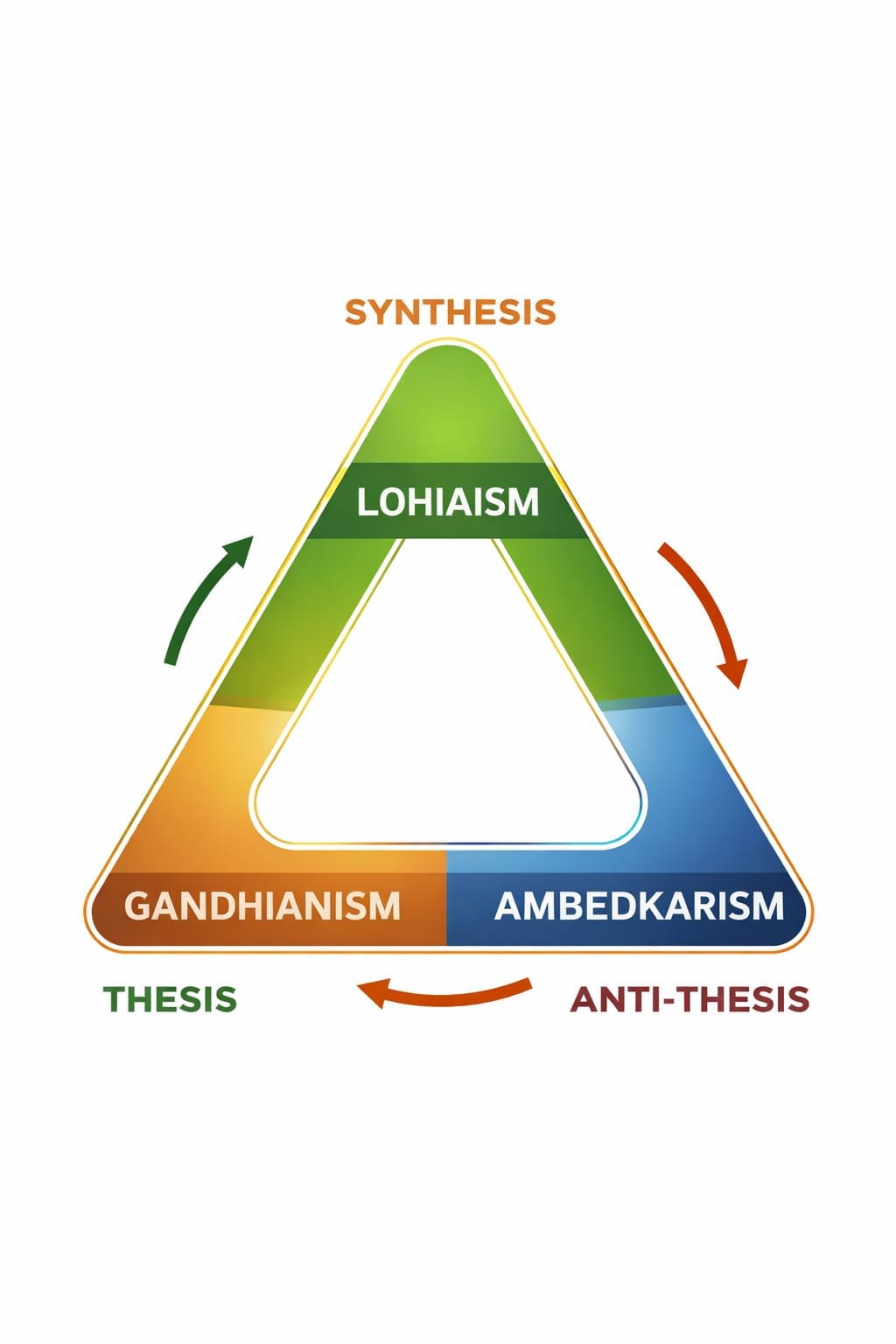
Yogendra Yadav, in his essay, “What is living and what is dead in Lohia?”[8] states how Lohia is an ubiquitous mixture of Mahatma Gandhi and Dr. Ambedkar. Many other scholars state that he is a heretical Gandhian. I propose that he is epistemologically a Hegelian. The ideology follows the Hegelian dialectic technique and is a synthesis of differing ideologies that are antithetical to one another, namely, Gandhianism and Ambedkarism. Gandhianism supports agrarian socialism, the supremacy of rural life, and the Indian social system without discrimination, while Ambedkarism supports industrial socialism, the supremacy of urban life, and is anti-caste. Therefore, Gandhianism is the thesis, Ambedkarism the antithesis, and Lohiaism is the synthesis. Therefore, Lohiaism is strongly anti-caste and at the same time values Indian villages and agrarian socialism, and this is what makes the ideology a toxic cesspool, which damages the Indian polity and State.
Lohia was dogmatically anti-elitist. It is hard to comment upon the nature of his anti-elitism, whether it was driven by ideological anti-elitism, whereby all elites are to be seen as enemies of the people, or he was anti-elitist because, in his words, “they were upper class, upper caste, and English educated”[9]. He himself was upper class, upper caste, and English educated. His higher education was conducted in Germany, due to his aversion to England and the English, but he published many of his works in English, not German. If elite theory and elite over-production is to be applied on his beliefs and situations, he formulated an ideology which was designed to overthrow the current Nehruvian elite and therefore was a leader of a counter elite movement, but I opine that he was a true believer, and his policy proposals have led to many of India’s current issues, especially his views on caste, industry, language and polity.
Industry
He came into contact with Marxist thought while studying in Germany, and while enamored by it in the beginning, he later went on to critique it for several reasons. The leader of the Congress Socialist Party(CSP) in the 1950s and 1960s led to the development of Lohiaite thought on the difference between Marxism and Socialism in his work, “Economics after Marx”, which is an incomplete work but is essential in understanding his view of Marx and industries[10]. Industries and industrialization led to the requirement of excessive resources for the production of cheap goods and while Lohia recognized Marx’s genius in seeing the the exploitative nature of capitalism towards the workers, he critiqued Marx for his alleged ignorance of the economic depredation that industries and industrialization with capitalism do, due to their need for cheap resources to the continents of Asia, Africa and Latin America as Marx saw imperialism as an aftergrowth of capitalism but Lohia saw it as one of the pillars of capitalism, the other pillar being industrialization. Therefore, he concluded that Marx was fine with draining the resources of Africa, Asia, and Latin America to provide a better life for European workers, due to this Eurocentric view of history[11]. It leads me to believe that Lohia saw industrialization and heavy industrialization, as a bad and avoidable thing, and given his closeness to Gandhi, this seems to be the conclusion Lohia came to with regard to industrialization. He used Gandhian ideas to counter the modernizing and industrializing instinct of Nehruvian socialism[12]. He was in support of small cooperative industries, which would help with material prosperity, and like Gandhi, he believed socialism would be achieved with decentralized governance with his Chaukambha model of governance[13], and that socialism entailed “equality,”[14] which would be non achievable with large industry.
Caste
During his tenure as the leader of the Socialist Party, the Indian National Backward Classes Federation merged with his party, and this led to his intersectional understanding of the caste system in conjunction with gender and class[15]. He wanted a broad coalition of disadvantaged groups, but for him, that group included minorities, SC/STs, poor GCs, and women. He was the originator of the idea of Other Backward Classes(OBC) reservations and even Economically Weaker Sections(EWS) reservations and was a champion of OBC politics in the Gangetic heartland[16]. He also believed that the upper class, upper caste, and English-educated elite wanted to keep this system down and oppressed through its machinations due to a mix of caste and class identity[17]. He advocated for having reservations for inter-caste married couples to dislodge, in his view, a casteist and classist elite who were the successors of the British colonial raj. While he seemed to have understood that South’s anti-Brahminism was borne out of their need to supplant the “brahmins”, and was just a way to establish their hegemony, he wanted to produce a movement which would be anti-caste and anti-elitist in nature[18]. He also gave examples of communities that used anti-caste rhetoric to push for the establishment of their own power but wanted the structure of the caste system to remain with them at the top. He wanted 60% blanket reservations for disadvantaged groups(minorities, lower caste minorities, women, non dwijas) in parties, bureaucracy, government and ministries[19].
Language
Lohia wanted a banishment of English from Indian society and the Indian nation and wanted it to be replaced with an indigenous language such as Hindustani[20]. He proposed that Hindi should be the official language of the Indian State and non Hindi speakers should be given reservation in government jobs for adequate representation until their state learns Hindi and adopts it within their state[21]. Yogendra Yadav claims that later he went on to clarify that he did not want to remove English to impose Hindi but just banish English and instead use Indian languages not because of nativism but because he saw English as perpetuating inequality and being a language of westernized elites, perpetuating feudalism and, he wanted a Hindi stripped of its Sanskrit leanings and be more Hindustani[22].
Polity
In his Aspects of Social Policy, Lohia conceives of a Four Pillar State the village, the district, the province, and the center, all having defined functions and integrated in a system of functional federalism.[23]
This is what Lohia envisioned, according to author A Appadorai. This policy position of his makes him seem like a libertarian socialist, as he believes that a strong centralized State would encroach upon the “freedom” of the people; the State has the capacity to engage in violence, which was in opposition to his Gandhian sensibilities. Lohia wanted self-sufficient villages with the small machines and wanted them to be community-owned, as property goes against his idea of freedom, and wanted these villages to have an amount of self-autonomy [24]. He wanted the idea of private property abolished[25]. He also seemed to want village republics.
Lohiaite Sins: An Indian Tragedy
While Lohiaite thought and its major policy proposals may seem intriguing, innovative, and unique, it is nothing but garbage, a senseless drivel of a socialist zealot who wanted to indigenize socialism and at the same time, have small cottage industries instead of industrial towns. A naive idealization of the village instead of the city, a defeatist position on the issue of language without any thought for the expansion of the linguistic-cultural identity that could be strengthened with innovative use of Sanskrit, and a debilitating borderline malignant scriptural understanding of the caste system with an intersectional framework. An ideology that has cost our most prosperous region(historically) in the Gangetic plain to languish in poverty, debilitating criminality, and a sense of hopelessness. An ideology is judged by its outcome, and Lohiaism, if judged by its output, is an ideology of feudal landlords, casteist strongmen and criminals which hollowed out the Gangetic plains of its cultural heritage, killed its chance for monetary prosperity, and obliterated any chance of a dynamic and just social cohesion.
Sins on Industry
If we look at the caste system, the group that has suffered the most at its hands are the Scheduled Castes, who were treated as untouchables due to their occupation or their “karmic sins”. Whatever the reasons may be, it is a travesty to treat human beings as inherently impure, and all of our leaders recognized this reality and took steps to remedy this situation.
Dr. Ambedkar advocated for positive discrimination, constitutional safeguards, industries, and urbanization. Barrister Savarkar wanted Hindu societal dynamism, industrialization, urbanization, and constitutional safeguards. Mahatma Gandhi wanted constitutional protections and societal reforms, but the fact remains that the Mahatma believed in Varnashrama Dharma, while Dr. Ambedkar and Barrister Savarkar wanted a new societal paradigm. This led to the former supporting villages while the latter supported urban places, and Dr. Ambedkar hated villages, unlike Veer Savarkar, who supported urban centers because Hindudom had been the strongest and most vibrant during the Gupta Era, one of the most urbanized eras of Indian history, with such influence that urbanism remained strong even after the empire ended[26].
Lohia’s support for village life, therefore, shows the inherent painful contradiction of his ideology. He is against the caste system; he believes that socialism is equality, but opposes large-scale industries, as the best way to establish new cities. We have literature that shows how industries and urban living decrease levels of discrimination and uplift the downtrodden through monetary upliftment.
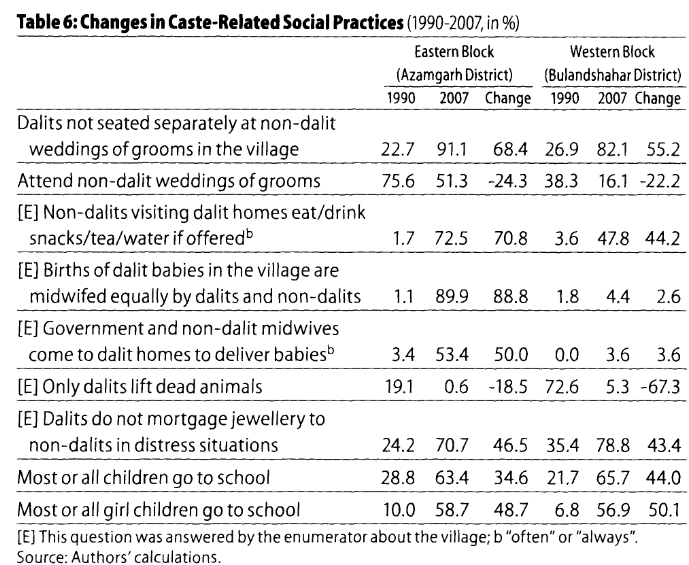
In the survey, the authors clearly found that since 1990 till 2007, the instances of social discrimination against Scheduled Castes have decreased and more so in the Eastern block of Azamgarh district than in the Western block of Bulandshahar district, but even in Bulandshahar, there is improvement in most factors. These numbers are directly related to the market reforms done in 1990 and the urbanization that followed these reforms.
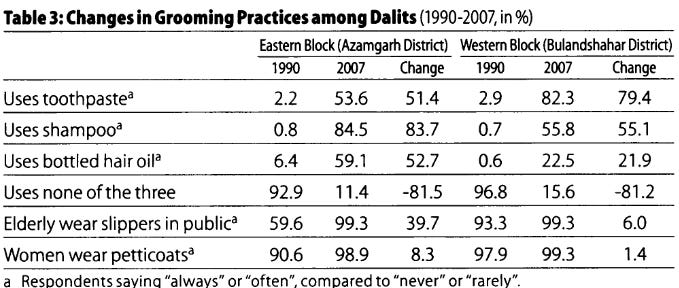
The changes in societal attitudes after the 1990 pro-market reforms, which increased our industrial base and urban sprawl, have had a big effect on the attitudes towards the Schedules Castes[27]. This is by every margin a victory for capitalist policies and a loss for the socialist drivel pushed forward by so many of our thought leaders. Capitalism, which Lohia saw as a pillar of imperialism, has led to better nutrition[28] and better consumption of grooming products by these disadvantaged groups, which should have always been freely available to them[29]. This proves beyond doubt that while Lohia’s intention may have been just, his negative opinion of industries and capitalism led him to support policies that perpetuated the feudal system he so opposed. Industrialization is what will lead to strong urban centers, which shall strengthen the Hindu civilization and also give all Hindus a fair and just chance towards monetary prosperity, and more than that, it will give the Hindu civilization a chance to expand and prosper in the modern world.
Sins on Caste
The Lohiaite view of the caste system is both perplexing and contradictory. They believe that Shudras have been discriminated against on the basis of scriptures, but at the same time also recognize their hegemonic nature in Southern States, but fail to see the same thing that was occurring in the North with the dominant caste in Uttar Pradesh and with the dominant castes in Bihar. These groups had been an integral part of the congress system as the feudal strongman, and even before Independence, had considerable social and political capital in the form of the Triveni Sangh. Lohia, through his naive formulation of the caste system, made it seem as if the Shudras had been heavily discriminated against, akin to the Scheduled Castes, which is a patently false claim.
M.N. Srinivas, in his book Dominant Caste and Other Essays, observed the hegemonic nature of the dominant castes in all secular matters of the village, two examples which come to mind are when the Dominant Caste in Ramapura village forced the Brahmins to leave the village when they were opposed in the elections with the help of the village brahmins, and when the Scheduled Castes of the village decided to leave the work they felt was degrading, the members of the dominant caste engaged in violence to force them to do the said action[30]. G.S. Ghurye, in his Caste and Race in India, talked about the intense intra-caste discrimination practiced by the Shudras within their sub-castes, specially the telis who had subcastes on the basis of the oil they extracted, the number of animals they used to extract the said oil, and the kind of seed for the oil or animal they used to extract the said oil, these subcastes practiced discrimination against one another on the basis of these factors[31], and Srinivas observed the same against the Scheduled Castes in his field study of Ramapura as stated above as the dominant caste in Ramapura village where Shudras[32].
The followers of Lohia’s ideology today are the Samajwadi Party and the Rashtriya Janata Dal[33], both known for their criminality, casteism, and feudalism. His sociology only pushed the dominant castes to claim an imagined victimhood, which led to the monetary depredation of the entire Gangetic region for over two decades. I would also like to state that this did not happen because of any specific community, but due to the nature of the Dominant Caste, any community in this situation will act in a similar manner. It is a fact that the implementation of the Mandal Commission, which is seen as Lohia’s victory, was headed by BP Mandal, a rich feudal landlord who claimed social backwardness. He could have advocated for better public primary-level education and industrialization, which would have helped the OBCs gain social respect and monetary success, but he condemned them to feudal violence at the hands of the dominant caste.
Sins on language
The only language that can unite India and be seen as a national language is a form of highly Sanskritized Hindi; any other option shall be rejected by the Southern States, as only a highly Sanskritized Hindi will be intelligible due to the Sanskritized nature of the Southern languages. Lohia could also have tried to Sanskritize English[34], but he did not due to his inherent dogmatic socialist beliefs. A static, degenerating linguistic culture instead of a dynamic and energized culture. He hurt the chance for Hindi to grow and at the same time made Hindi seem as a parochial imposition. Gandhi’s method of promoting Hindi was superior to his heretic successor in this regard. The Hindi language, which was strengthened through the highly Sanskritized poetry and its idiomatic expression being hollowed out with regard to its Sanskrit character, is a travesty, and for it to be followed as a policy, a national treachery. It ignores the various historical reasons that led to Hindi being Sanskritized. I have no comment on his policy of reservation for linguistic minorities because it is nothing but the policy of a lobotomized mind.
Sins on polity
The decentralized model of governance he advocated ignored both Hobbes and even the ancient Indic formulation of Raj Dharma. A.S. Altekar states that it is the duty of the State to establish dharmic Nyay and abolish Matsya Nyay[35]. Hobbes argues that the State, through its coercive power and monopoly on violence, allows the innocent to practice their trade, rights, and be safe. His mindless decentralization led to Jungle Raj in Bihar and the formation of caste militas, which led to the State government losing its monopoly of violence, which only led to the suffering of the poor and disadvantaged groups he wanted to protect at the hands of the feudal elements, which he so detested. The caste militias existed even for those communities that were Shudras in Lohia’s framework and, through it, claimed victimhood, except that they had the resources to have a caste militia, which summarily shows their dominant position in society and the false nature of their supposed victimhood. The only acceptable form of decentralization is the strengthening of the union government and the urban centers, and the weakening of the states.
Lohia and the Sangh Parivar
When the Janata Party was abandoned by many Jana Sangh members over the RSS dual membership controversy, the BJP or the Bharatiya Janata Party was formed in 1980, and wanted to prove that they were the true Janata Party, not a breakaway faction[36]. The Janata party was a Lohiaite party[37] and had the blessing of a colleague of Lohia, Jayaprakash Narayan, who held the same beliefs as Lohia[38]. The BJP declared that its ideology was Gandhian socialism, not Hindutva under Atal Bihari Vajpayee[39]. They had formally adopted the ideology of Gandhian socialism and would have followed it if not for the intervention undertaken by Rajmate Scindia, who ensured the adoption of Hindutva and Integral Humanism as the party’s ideology[40]. Sitaram Goel, in his book, “Perversion of India’s Political Parlance”, states that he advocated for the Bhartiya Jana Sangh and the RSS in front of Jayaprakash Narayan and took him to meet the members of both organizations[41]. Therefore, there was an association between Lohia and the BJP, but there was an aesthetic similarity in thought. A hollow association, but a valuable one given the socio-political conditions. Lohia, like the Sangh Parivar attacked the Nehruvian left academia[42] and was ignored by them which must have led to a feeling of alikeness for the Sangh Parivar. His anti-Congressism also gave many socialists a justification to ally with the Sangh Parivar who in other times they would treat as lepers, worthy of isolation and to be ignored in both public and private life, this led to a feeling of camaraderie between the Sangh Parivar, and Lohia which also led to a digestion of Lohia’s thought[43].
Lohia more often than not invoked Hindu gods and fables to describe different behaviors and beautifully pontificated on the tattva of different Hindu deities. His essay, “Ram and Krishna and Siva” was one such essay that captured the imagination of many on the political Right[44]. This was the Nehruvian era, and Nehru was anti-conservative. He was apathetic and dismissive towards Hindu cultural icons, if not hostile towards them, and Lohia, who was a staunch critic of Nehru, openly embraced these icons, which must have seemed like a breath of fresh air to the Bhartiya Jana Sangh. He organized Ramayan Mela to showcase the essential unity of India through the many languages in which the epic of Lord Rama is retold[45]. He stated how Ramayana united the North and the South, and Krishna Bhakti in the East, and the West[46]. The EWS reservations implemented by the BJP are also a product of Lohia’s thought.
These factors led to the BJS and the BJP to absorb many parts of Lohia’s thought, which has had a detrimental impact on the BJP. It is as covered in the above section, a toxic cesspool for our civilization due to its view on industry, polity, caste, and language.
Conclusion
Lohia perpetuated the very feudal system he was so against and was responsible for the establishment of one of the most toxic forms of caste politics seen in Northern India, and condemned the people of the Gangetic plains to poverty, violence, social conflict, and criminality, a failure by every metric. He was a true believer of his ideology and wanted to overthrow the Nehruvian hegemony established after Indian independence with a variant of Gandhian socialism, and he did just that, by obliterating the Congress system by energizing the dominant caste under a false victimhood and by breaking the Nehruvian elite and Muslim elite alliance by creating a new alliance of the dominant caste and Muslim elite. His ideas worked; in making India more like a dystopia than a better place, proving that Nehru’s approach, while wrong, was better.
The BJP needs to cut out this tumor-like ideological growth and pursue policies that will propel India to become a prosperous, strong, and dynamic civilization, but at the same time ensure it remains rooted, cultured, and united, which requires a lot of ideological churn but within the Hindutva framework and not with ideologies that will lead to the ruin of both our people and civilization. Hindutva, with its free market corporatist framework and dynamic cultural revivalism, has done India a lot of good in the past decade, but the ills with the BJP that many people see are due to their fusion of Lohiaism with Hindutva, the nihilistic social justice, the lionizing of village life, and the insertion of caste into arguments where it has no place. The embrace of Dr. Ambedkar, which many on the Right criticize, is also due to this Lohiaite component because none of the BJP’s policies have anything to do with Dr. Ambedkar’s ideology. The reservations that have increased are those of the OBCs and women, not SCs. Time for even the “dissident Right” to take stock of what they want to accomplish. I was ignorant of this, so this is not an attack, but a call for a recalibration of our views.
References:
https://cshc.substack.com/p/economy-and-orthodoxy?utm_source=publication-search
ibid
What Is Living and What Is Dead in Rammanohar Lohia? pg 3
Lohia’s Socialism: An Underdog’s Perspective pg3
ibid pg2
ibid pg 3
LOHIA’S QUEST FOR AN AUTONOMOUS SOCIALISM
What is living and What is dead in Lohia?
India’s Power Elite pg 16
Context, Discourse and Vision of Lohia’s Socialism pg 3
ibid pg 4
ibid pg 5
Recent Socialist Thought in India by pg 11
ibid pg 3
Understanding Lohia’s Political Sociology: Intersectionality of Caste, Class, Gender and Language pg 2
On Remembering Lohia pg 2
Understanding Lohia’s Political Sociology: Intersectionality of Caste, Class, Gender and Language pg 4
ibid pg5
ibid pg 6
What is living and What is dead in Lohia? ibid pg10
ibid pg 10
ibid pg 10
LOHIA’S QUEST FOR AN AUTONOMOUS SOCIALISM pg11
ibid pg4–5
ibid pg4
Urbanism in Post-Gupta Period: Insights from Epigraphy and Literature
Rethinking Inequality: Dalits in Uttar Pradesh in the Market Reform Era pg8
ibid pg 6
ibid pg 5
Dominant Caste and Other Essays pg 1–19
Caste and Race in India pg 168
Dominant Caste and Other Essays pg 96–115
https://theprint.in/report/bearers-of-ram-manohar-lohias-philosophy-in-todays-politics/12273/
Sanskrit Non- translatables
State and Government in Ancient India
The New BJP pg 397
https://theprint.in/report/bearers-of-ram-manohar-lohias-philosophy-in-todays-politics/12273/
Recent Socialist Thought in India
The New BJP pg 399
ibid pg 400
Perversion of India’s Political Parlance pg 5
On Remembering Lohia pg 4
What is living and What is dead in Lohia? pg12
What is living and What is dead in Lohia? pg 6
On Remembering Lohia pg 2
Lohia’s Socialism: An Underdog’s Perspective pg 5
Bibliography:
The New BJP by Nalin Mehta
India’s Power Elite by Sanjaya Baru
Caste and Race in India by G.S. Ghurye
Dominant Caste and Other Essays by M.N. Srinivas
Sixth of Humanity by Devesh Kapur and Arvind Subramanian
Sanskrit Non- translatables by Rajiv Malhotra
State and Government in Ancient India by A.S. Altekar
Perversion of India’s Political Parlance by Sitaram Goel
Lohia’s Socialism: An Underdog’s Perspective by Sachchidanad Sinha
LOHIA’S QUEST FOR AN AUTONOMOUS SOCIALISM by ADI.H Doctor
What is living and What is dead in Lohia? by Yogendra Yadav
Context, Discourse and Vision of Lohia’s Socialism by Rajaram Tolpadi
Recent Socialist Thought in India by A Appadorai
Understanding Lohia’s Political Sociology: Intersectionality of Caste, Class, Gender and Language by Anand Kumar
On Remembering Lohia by Yogendra Yadav
Urbanism in Post-Gupta Period: Insights from Epigraphy and Literature
Rethinking Inequality: Dalits in Uttar Pradesh in the Market Reform Era
https://theprint.in/report/bearers-of-ram-manohar-lohias-philosophy-in-todays-politics/12273/
https://cshc.substack.com/p/economy-and-orthodoxyutm_source=publication-search
Well written! It is necessary to shift our gaze towards the elephant in the room of Indian politics, i.e., Lohia. The man who, much like Marxism, has seeped into various political ideologies and influenced them in his own way. Lohia won the longer battle and has threatened both Nehruvian secularism and Savarkarite Hindutva equally. He is not Gandhi, not Nehru, not Savarkar, not Ambedkarism but gathers all the elements from them that could make for a potent pan-India anti-elitist ideology. Nobody can be credited more for inverting the triangle than Lohia. Kudos to Manomay for this effort.
I only disagree about the Sanskritised Hindi imposition part. Many Reg Languages are organically more Sanskritised than Hindi. Like Bangla being an Eastern Indo-Aryan language has more Sanskrit derived Tatsama (& ofc TatBhava) in daily usage than Colloquial Hindi (which is nothing but Urdu in Devnagari with lesser Farsi aka Hindusthani) or even the artificial Sanskritised Hindi ( which isn't organic while ours is already deeply organic). So Reg lang for local purposes or even national integration via mutual exchange & Modern Sanskrit (Sanskrit Bharati? ) shall be our version of Israelite Hebrew rejuvenation with English for technical purposes.