
On The Democratic Element
Why India lacks it and how it can be remedied.


Although our republican government is described as the world’s largest democracy and has managed to have a well-run non-monarchic form that has flourished since the end of the British Empire in our land, it may seem superfluous to talk about democracy. Nevertheless, I consider it to be no mean thing to talk about the democratic element, and against all conventional wisdom, defend it as a facilitator of great prosperity.
The democratic element, defined
The ancients understood the popular element as being sovereign when it could exercise power, and to exercise power means, and meant to be able to issue orders and have them implemented.
But unlike a monarchy, where all sovereignty belongs to the king, a constitutional government has it in a group. When the group is small, it is an oligarchic government, and when it is large, it is a democratic government. The small group, is known as the notables, while the larger group, is known as the populace
The democratic element in action: A brief history
The formal theorization of the democratic element, in its earliest form, was conceived in Athens, by Aristotle and Plato. While Athens was not the first, it was the most prominent of states to have a significant democratic element. The older systems in the other states of Greece were predominantly centered on the nobility and the King, with popular elements being insignificant. From monarchic governments, the states switched to oligarchic forms and further into democratic forms of government.
The switch to Oligarchy began when the Kingly office proved to be corrupt and oppressive, and as other families started to gain power equal to the king, they transformed the state into an Aristocracy, where the best of men ruled for the common good.
The Aristocracy in the same way, grew licentious over generations, making itself an oppressive lord above the many, and degenerated into an oligarchy.
Subsequently, Oligarchy was replaced by Popular Government, which is where every free man of the citizen stock had a share in power, and with his fellows, helped administer the city.
Similarly, this state across generations became a state where everyone lived in his own mode, with no regard to the common good, and was subsequently replaced by a Monarchic government, with the cycle continuing perpetually, at least in theory.
But such is not found to be the case, for a state rarely can pass through such changes and still be the same state after many cycles. This is because after many generations, the conception of a state changes, and even if one returns to a certain form, it will never resemble the older iteration of the same.
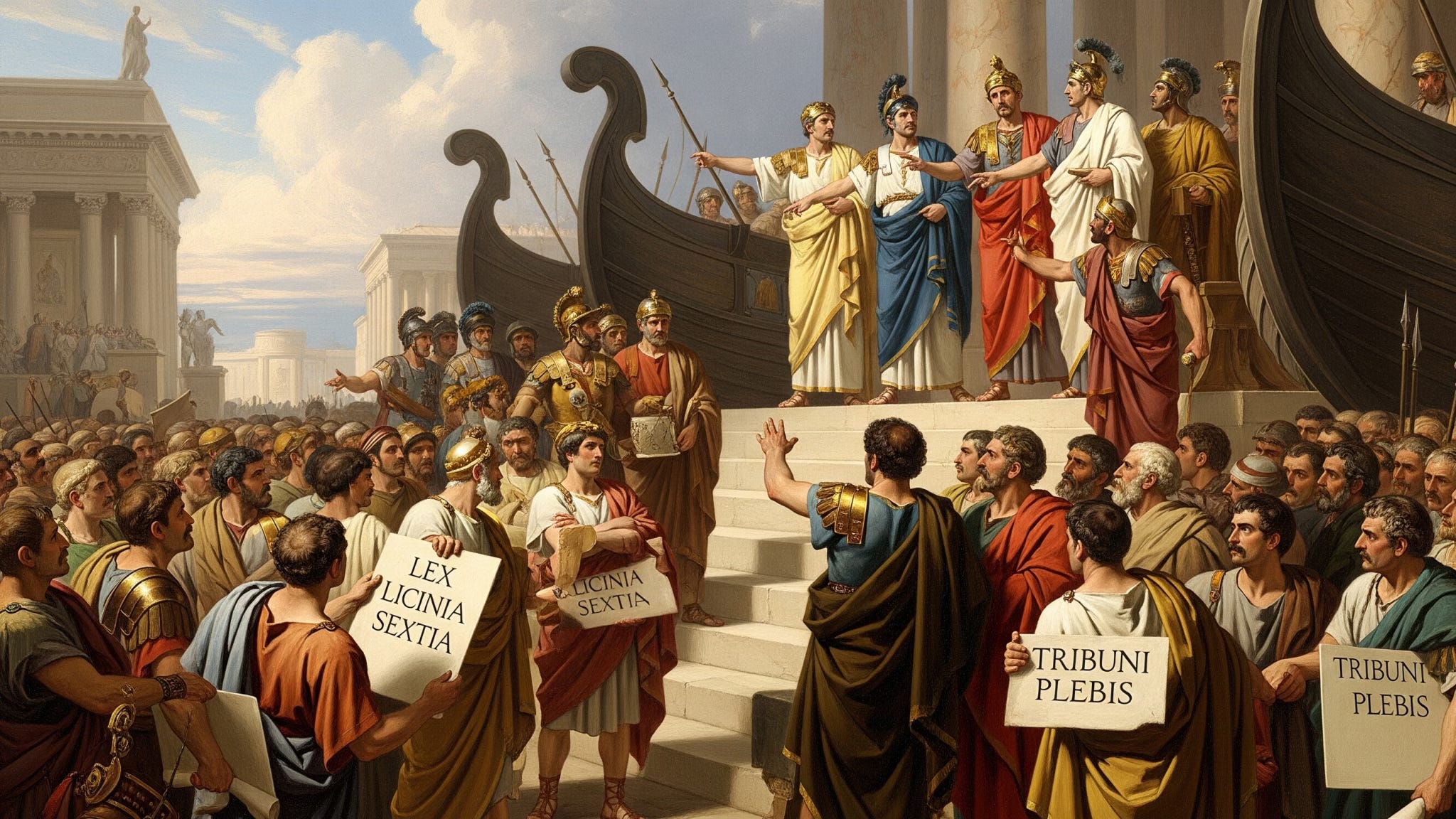
One can see this cycle in Rome. From its beginnings as a Kingdom, with power centered on the King, the expulsion of Tarquins paved way for its transformation into an oligarchy led by the Senate, with a brief period of rule by the Decemvirates. Subsequently, it achieved the structure of a government balanced well between Plebeians and Patricians, with the consulship open to both of these.
As the Republic grew, so did its problems, which led to strongmen like Marius and Sulla becoming demagogues, culminating in the rule of Julius Caesar, that led to the demise of the republic, to transform it into an empire under his adopted son Octavian, later known as Augustus.
In this case, one sees that the Empire was not similar to the Kingdom until the days of Marcus Aurelius, for the Praetorian Guard played a major role in politics, after the Emperor, as well as the Senate, which was absent in the Kingdom. The same can be held to be the case in Athens, as it switched from the Solonian constitution to the tyranny of Pisistratus, the constitution of Cleisthenes, to the oligarchies installed after Pericles’ death and defeat by the Spartans, until the restoration of the democratic form which was yet different from the constitution of Cleisthenes.
These two examples illustrate thus, how constitutions change and how the same form never returns.
The democratic element leads states to unprecedented greatness
Even though modern Hindu political thought disparages democratic elements and the form itself, considering it as an impediment to greatness, it is not the fault of the form, but of the way in which it is ordered.
Every state, when it is established, is ordered by its founders and leaders in certain ways. Either it may be perfectly ordered in the beginning itself or ordered well enough to be on the right path, or it may be ill ordered. When it is well ordered, like in Sparta, it endures for a long time, as is seen in Sparta’s five centuries of sovereignty being lived without changing the laws of Lycurgus significantly. In another case, it may have a good beginning, like Rome, where the Republic from giving nothing to the Plebeians, gave them equal rights as Patricians over two hundred years. In the last case, one sees a state get never achieve the perfect end, as it happened with Athens, which eschewed the laws of Solon that were well balanced, for tyrants, another form of democracy, many oligarchies, and yet another form of democracy that resembled very little of its predecessors.
Now if one sees the first two cases, which are good, one sees that the goodness of the democratic element never has been utilized to its full potential, except by mixing it with a princely power, which means effectively magisterial authority, as well as an aristocratic power, which means a body of elders, or of the best of men in the political arena.
Even though such examples have been seen in the world, one is yet led to doubt their effectiveness, as one sees states which have no apparent mixing of the forms, become great in the world.
To this, it may be said that a state that wishes to become great must be able to utilize its populace in war, and other endeavours where one must assert power over other states. The rise of Athens and Rome is seen to happen when their populace starts to participate in power, and their empires peak in such configurations.
One sees the same being the case with India, for when it becomes a country not run by kings, but by the masses, even while they do not share as much power as an Athenian or Roman did, it achieved more than what all Indian political entities in the past ever could achieve. The same is the case with the Americans, the Russians and the Chinese, as they grow exponentially when power goes out of kingly hands and into the hands of many.
In contrast, states with no mixing of the elements have been seen to stagnate and be unremarkable as powers. Such is seen with the many dictatorships today that are unremarkable and have no relevance on the world stage, while pure Aristocracies do not exist anymore, except as secondary elements in governments.
Why such a greatness results, is due to how human nature works. In suppressing the power of the populace, the wisdom of the notables assumes that it can lead the people better in all circumstances, which is far from the truth. Human nature itself is such that a man does not change his modes by himself, with great prudence, and even though his fortune varies with time, he hardly can vary his modes. The notables, being few, can never vary their modes beyond what their group has been raised to believe in, and when the time comes to change them, they are slower to respond, which becomes perilous to the state.
In contrast, the populace is never a uniform group, and one finds variation in their modes, far in excess of the variation found in the notables. This itself creates many men that can navigate a greater variation in fortune than notables alone can, and that makes these states last long, as has been seen with the Roman republic that survived for 482 years, the Venetian republic that survived for more than a thousand years and the Spartans that survived for 800 years.
Most states today cannot be considered democratic, despite having elected leaders
Although one may take the definition of democracy as being a government where leaders are elected from multiple parties, after a fixed period, with a Legislature, Executive and Judiciary being the three organs of government with the former of these three also being elected, it is not necessarily an indicator of being a democracy.
In applying the definition of the ancient Romans and Greeks, democracy must mean that the populace can issue commands and have these obeyed. In most of the states today, the populace can only command the change of leaders, and beyond it, has little say in what gets done in the government, where it is entirely at the mercy of those it chooses to lead it.
This way of functioning, where the legislators and officials do not have further obligations to the people after election and appointment to the office, is known as a free mandate. Here, the government officials are entrusted with authority to run things as they see it fit.
But men are wont to be evil, and “one must presuppose that all men are bad, and that they always have to use the malignity of their spirit whenever they have a free opportunity for It. When any malignity remains hidden for a time, this proceeds from a hidden cause, which is not recognized because no contrary experience has been seen. But time, which they say is the father of every truth, exposes it later.”
It is thus no surprise, that one sees governments become entirely in thrall to petty interests that privilege their welfare over the common good, when such a system is allowed to govern, for it creates an oligarchy under the guise of a democracy.
The contrary to this is the imperative mandate, where the legislators are entirely bound to the instructions of their constituents, which is as close as one gets to a democracy in its essence. Yet it is not something that a modern government can consider, for it creates a dissonance between provinces, cities and districts. This is because in such a system, the representative must exercise the will of his electorate, which may not be fulfilled and may be in opposition to another representative’s electorate.
Now such a system, that denies agency to the populace, is no democracy, despite being considered one by modern convention. Nor can one also support the imperative mandate, which breaks apart states into entities that are weak by themselves.
Nevertheless, a case in our world still persists, which shows how the ill effects of the free mandate may be counteracted, without needing to break the state down to minuscule entities that can never become great by themselves, which we shall see further, when we examine the mode of the Swiss.
The democratic element in action
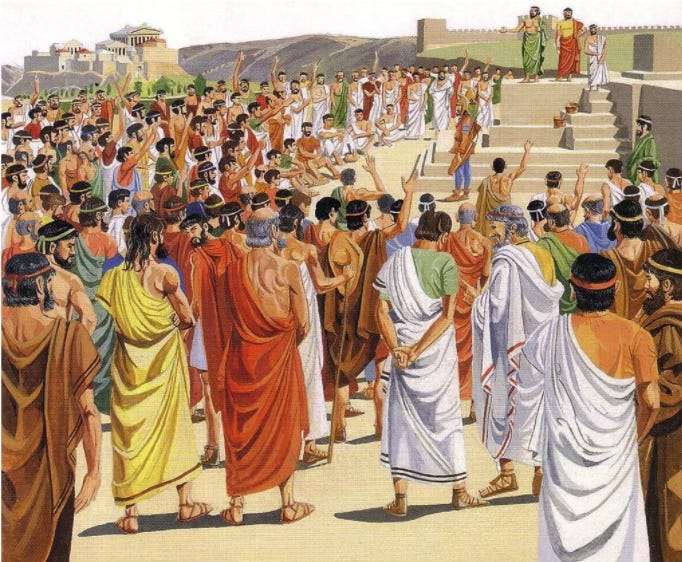
Now when one sees the democratic element and its features, one must know that at the core of authority, lies the ability to issue commands and have them carried out, which is the essence of power. In fact, the rulers and the ruled are the same in a democracy, hence “to rule and be ruled” is the essence of democracy.
Thus, in the democratic element, the populace together, can do more than choosing the leaders, and there are three things that can be done. They may assent to a proposed legislation, they may propose a legislation, or they may dismiss their representatives. In addition, as Aristotle says, they may participate in judicial functions.
One sees the participation of citizens in the Judicial function, as well as the ability of dismissal of government officials, in the United States of America, which has let the citizens be a part of the government machinery, keeping them less aloof, compared to most countries.
Yet one sees all the features in Switzerland, where the most robust democracy has existed for over a century, with little political turmoil due to how much trust the government puts in the citizenry.
Against the sceptics of the instruments of direct democracy
Although the instruments of direct democracy are seen to be allowing the populace a greater say in political affairs, one still finds those who doubt the efficacy of these. Yet these doubts are never from a deep study of things, but due to predilections of men, who, as has been stated, are wont to not vary their modes, while fortune varies with time. They consider that the notables are people who have such virtue, which can sail through all the vexations of fortune, but such men who can be successful in all times, are rare, and to count on one type of people, is just like the farmer who guarded a tree stump and waited for a rabbit.
Furthermore, some may say that the people can only have so much leisure to decide on matters that are of greater importance, and instead of burdening them, let the matter be delegated to the notables, to which it may be said that when one orders his state to involve people in exercising power, he necessarily also provides them the time to deliberate and decide on matters.
While it may be a great endeavour to refute every argument that opposes popular sovereignty, such is not necessary due to the many examples that we have seen in history and in our times, that prove the viability of such systems.
But let us come to India, where it shall be demonstrated how popular sovereignty can lead it to a greatness that is greater than all that it has achieved till now.
The lack of direct democracy in India
Although one sees in history, that there were constitutional governments in India, one does not see any examples of popular sovereignty documented except in Greek sources and in the Mahābhārata etc, which, due to the paucity of details, leave a lot to be desired. Where one gets details, one sees that it is not a system that can be considered democratic since sovereignty always lies with all families of the resident Kṣatriya-s instead of the entire populace. The village republics too, as in the case of Uttiramerur, do not speak on popular sovereignty, and except for the elected men, there is no power to assent to decisions or propose any measure given to the ordinary villagers.
While one may attribute it to many reasons, I consider that it may stem from the inability of the village or the state’s populace to become one body, which is exacerbated by the diversity in customs as well as self-segregation among the communities that prevents their mobilization for exercising political power.
Beyond societal reasons, one sees that as the empire of the Britons receded, there was no great agreement among the Indians as to what their government would look like. With the threat of unravelling of the territorial integrity after partition looming, the old order with modifications, continued. This order in the states of the Commonwealth meant and means power being in the hands of an assembly which cannot be dismissed except after every five years. Such a system, with no safeguard for the populace against the notables, made the system an oligarchy masquerading under the name of democracy.
Nevertheless, with the improvement in conditions, there is no reason why such a system cannot be devised, for it is the common good that makes states great, and not the particular good. By involving the populace in matters of power, one reaches greatness in a really short time, as did Rome, and Athens, once they overthrew the Kings and tyrannies respectively.
Benefits of the instruments of direct democracy
Although much has now been spoken of the good that the system of direct democracy may bring, it is nevertheless imperative to see the good in every instrument of direct democracy that is practised in our times.
The referendum is the first among instruments, for it lets the populace decide whether any measure may pass or be rejected. This instrument, among the Swiss, is frequently utilized, at the federal level, provincial level and local level. Just like in India, with state, union and concurrent lists, the Swiss also have a distribution of powers and responsibilities, divided between the federal, provincial and local levels, and referendums are thus defined in their scope according to the domains assigned by the law. In addition, referendums may be optional or mandatory. In the former, it may be utilized in case some law proposed is disagreed to, and a vote may be forced which can either lead to withdrawal of the measure, or for the measure to continue. In the latter case, it is seen that when there is any change in the constitution, or any proposal is made to join a transnational organization, there is a mandatory vote, which decides whether the country joins or not, or if the proposed change is passed or not. This measure is merely used to agree or disagree with a measure and veto their passage or assent to them.
The initiative in contrast is one which proposes measures from the populace, that are subsequently sent to the legislature and either accepted, rejected or have counter proposals made that address the concerns of the proposal, which in turn can also be either accepted or rejected.
The last is the recall election, which is in effect a referendum on the continuation of an elected official in office. Although this form is only limited in its usage in Switzerland being practised only in six cantons, it finds a greater use in the United States. Unlike the other two measures, it is the one measure which gives immense power to the populace against the officials. Nevertheless, this measure is dangerous when applied to elected officials, for the electoral campaign that results from this ends up becoming a burden on the treasury.
But to see successful examples of initiatives and referendums in Switzerland, I consider one of each to be enough. In the former, I shall state the popular initiative of 1994 in favour of railways instead of roadways in the Alps for freight, and in the latter, the rejection of the joining into the European Economic Area, in 1992.
In both cases, one sees the great wisdom of the people, for in the former, they understood that the fragility of mountain systems was real and so was the need to maintain economic activity, and this was their way to approve a middle path, instead of taking to extremes. In the latter, one sees an understanding of sovereignty, that would be lost if they had approved the joining.
Now if one sees these examples, it is made clear that when matters of the state are given in hands of the people, they will certainly show great prudence, for in this, they understand the gravity of being the rulers, not merely the ruled.
Even though the benefits are seen thus, these are rejected for spurious reasons of cost, time and an inability to present measures in simple language. I consider, regardless, that a country which can conduct local and national elections almost every year at a scale comparable to most countries in the world, can certainly implement these, and the obstacle is merely a lack of trust and political will.
Remedying the lack of direct democracy in India
Although the Swiss are the only example of a state with direct democracy that has functioned remarkably well, it is nevertheless dismissed by the wise, who consider in their wisdom, that one can never scale it to a country of the size of India, and the state closest to our size functions well without this form.
To this, it must be said that given how Independent India’s provinces and districts suffered when tyrants took over, the democratic form is the only thing that prevents us from sinking into greater chaos. As for the democratic system being an impediment to greatness, that stems from an ill ordered state, and not from the size of the franchise. Nor does it help that in India, one sees provincial governments being stronger than the central and local governments which make administration harder.
So the first remedy thus, is to order the state from being a rent seeking behemoth, that harasses powerless citizens, into one whose custodians are the citizens, for the government of the people must have people being rulers in reality, and not merely in name. This itself presupposes many things that must be done socially, of which we shall speak later.
The second remedy, then, is to establish the infrastructure for conducting referenda, initiatives, and recalls, as well as jury trials. What instrument shall be taken up out of these, shall depend on the circumstances of a region, but the establishment of such infrastructure shall be imperative.
The competence of the Election Commission of India is well known, and there is no doubt in its reliability in conducting elections nationwide as well as in states. Knowing this, there shall be no trouble in establishing an infrastructure to conduct referenda, to propose initiatives and to have recalls for government officials across cities, districts, provinces and the entire territory of India.
Once one has the infrastructure in place, the next shall be to decide the list of matters in which the citizenry can take decisions. This means devolving state power to the citizenry, reducing the scope of the authority of the officials while increasing it under this infrastructure, for the citizenry.
The third remedy, then, will be to test these in cities, districts and provinces, and have these conducted frequently, like in Switzerland, with one to three referenda every quarter, and recalls as well as initiatives being conducted frequently and implemented with no qualification that dilutes the decision taken.
The dangers to implementation of such a system
The implementation of such a system is yet not without peril, and the causes for this may be either from the notables, or from the inexperience of the people in self-administration.
To examine the former, it is understood that the notables will endeavour to keep the popular spirit suppressed and will try to dilute these decisions with legalist machinations. One sees this in the Brexit referendum, where it took many years to implement the referendum with
The other danger arises from demagoguery, which deceives the populace by assuring it of things that will never be delivered without danger to the state’s existence, and which is in fact, a way to take away the freedom of the people.
Finally, the last arises from inexperience of the people, which is a danger but only in the initial stage, for decisions in many cases can be reversed, as seen in Rome where the consular office was reinstated after the second decemvirate as the people realized their folly with time.
There are further dangers, that Aristotle and Machiavelli talk about, which threaten the integrity of democratic structures, for which another article may suffice to discuss.
Conclusion
The monarchic government, despite its antiquity, is best suited to states whose populace is entirely unruly and can never order itself for a political way of life. As has been said, “where there is a prince, a republic cannot be made, and where there is equality, a kingdom cannot be made”
In our times, with the elimination of secular hierarchies which segregated men according to their station, and with the implementation of equality in India among Hindus, there is no reason why, with all the examples in history, a system with direct democratic instruments shall not be conducive to prosperity for India. Contrary to the sceptics, a population with great ambition, when allowed to share in power directly, ends up taking states to hegemony. Such thus, will be the case, for India, with her experience in constitutional forms from classical antiquity.
References:
Niccolo Machiavelli, Discourses on Livy, translated by Harvey Mansfield
Aristotle, Politics, translated by C.D.C. Reeve
 | A guest post by
|