
Charles De Gaulle
The birth of French strategic autonomy


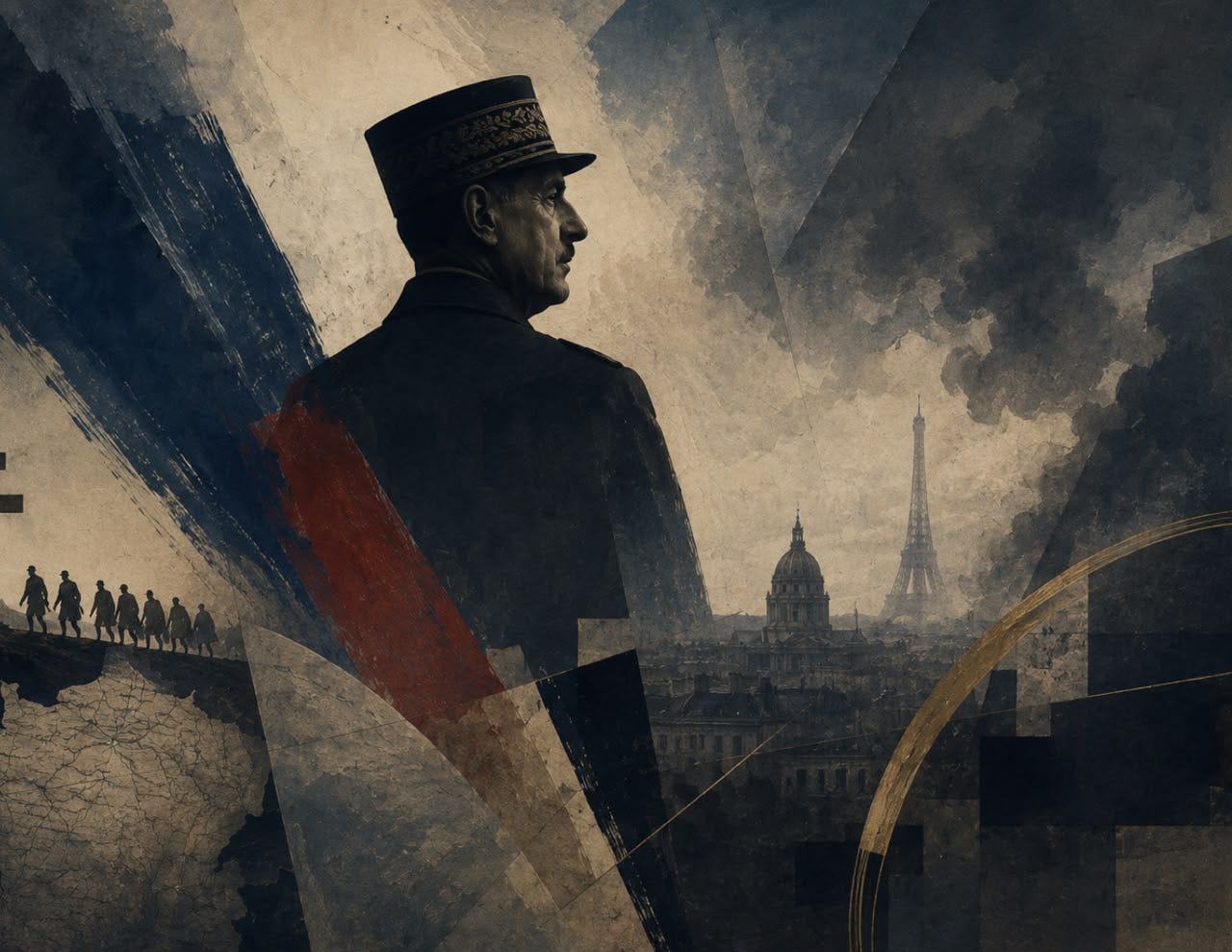
As the world order that emerged since the Soviet Union’s disintegration collapses, we are entering an era characterised by increasing contestation between great powers and nations. As the US is increasingly becoming transactional under Donald Trump—whose foreign policy has been characterised by many as a crusade against the rule-based law and order, an order which for many scholars never existed, as world powers have always flaunted the mandates and sovereignty of nations at their will (which is a debate in itself)—we are increasingly seeing the gradual reduction of strategic space for many countries and nations. Complex interdependence, once seen as a force that could pacify and reduce conflicts between nations, has become a new tool for subversion and a tactic used by powers to force other parties to compromise. Trump’s constant threat of tariffs is a great example.
The equation becomes more complex with China’s introduction and its growing influence. China’s dominance over rare earth materials and critical minerals, which can function as a choke point, poses a serious threat to nations’ social and economic stability. Therefore, it is important that nations develop a new strategy to overcome these challenges, and here I believe the thoughts and outlook of Charles de Gaulle can be a great start.
Charles de Gaulle perhaps is one of the most celebrated personalities of WWII. His will, valour, and leadership defined and guided the French struggle against Nazi occupation. From an exiled soldier to rebuilding the Free France army and then leading the Provisional Government was a tumultuous journey; his historical ascent to power in 1958 is a tale in itself, and his ideology, which erected the foundations of the modern French nation, is equally legendary. While it is true that De Gaulle was always a social conservative whose deep and personal belief in traditional Roman Catholicism built the canvas for his worldview, it was the circumstances of World War 2 that fundamentally restructured his philosophy towards France’s polity and governance.
The originator of a distinct theory of statecraft now known as Gaullism, he rooted his ideology in nationalism, celebration of heritage, protection of state sovereignty, and an absolute, uncompromising attitude towards the country’s autonomy. Gaullism in a contemporary sense is characterised by strong political leadership (i.e., a powerful executive), preserving the nation’s autonomy while driving foreign policy, and a strong defence that is devoid of any foreign assistance and aid. Two chief elements of Gaullism are Grandeur and Independence. Using these principles, the General, during the height of the Cold War, was able to carve out a foreign policy in which his aim was not only to protect France from the Soviet Union’s shadow, but also from ever-increasing American intervention in the affairs of Europe.
As China grows more powerful and the gap between it and the US narrows, there is a possibility that the world might again rupture into two camps or alliances mirroring the Western and Eastern blocs, with neighbouring nations’ sovereignty vanishing as they are forced to act as satellite states. Some scholars have predicted that the two powers might compromise and create their own spheres of influence, where any intervention from one power would be discarded provided the other power shares the same sentiments. Either way, it becomes imperative that nations that are not as powerful and lack the same influence as China and the US create a new strategy to overcome emerging challenges, managing new alliances that threaten their influence-free internal workings and sovereignty. Therefore, reading and understanding Charles de Gaulle’s ideology becomes important, and it can act as a blueprint for many countries and middle powers to create their own coherent framework so that, when time demands, they are better prepared to manage such developments.
In this article, I have tried to outline some of the important events to create a background that was crucial for the development of the General’s ideology. The discussion is brief but provides enough substantial information to help readers appreciate De Gaulle’s thinking. Broadly, the article is divided into two portions: in the first half, I have traced De Gaulle’s journey, his frustrations with party politics, the collapse of the Fourth Republic, and the subsequent creation of the Fifth Republic, of which he was the chief architect. In the second portion, I have discussed the two important principles of his vision—Grandeur and Independence—which include his infamous Nuclear Doctrine and its evolution.
“Defeated, Humiliated and Occupied”
At the outbreak of the Second World War, France entered the conflict alongside Britain after declaring war on Nazi Germany on 3 September 1939 following the German invasion of Poland. Despite the political rhetoric and grand show of a united front, what characterised the initial months of the war was the attitude of the French Nation and French Army towards Hitler’s threat. This period later came to be known as the Drôle de Guerre or “Phoney War,” with relative inactivity on the Western Front. Anthony Beevor notes that after a huge hysteria of mass destruction, “life quickly became normal”. There was a sense of indolence among French soldiers, who in some cases even avoided firing at the wandering German soldiers near their lines; “German propaganda continued to encourage the idea that the British were getting the French to bear the brunt of the war”.
Many critics had already pointed out the critical weaknesses in the French Defence, notably its army. The French Army, which was considered one of the most powerful armies in the world, still relied on the old and outdated strategies of World War I. Marshal Tukhachevsky had pointed out its inability to hold its defences. He stated that the army was “too slow to react to an attack,” not just because of the defensive mentality, but also because it “lacked radio communications”. French military strategy relied heavily on the defensive Maginot Line, another relic of WWI whose 400,000 casualties have haunted the country for years. Political scandals, fractured unity, and the Third Republic’s lack of determination had aggravated this environment. This strategic miscalculation proved disastrous when Germany launched its Blitzkrieg offensive in May 1940, bypassing the Maginot Line through the Ardennes Forest and rapidly overwhelming French defences, which were taken by surprise. So unexpected and unprepared was the French army that within six weeks, Paris fell to German forces on 14 June 1940, triggering one of the most humiliating defeats in French history. Efforts to counterattack and create some relief all went in vain, and events finally culminated in the evacuation of British and French forces from Dunkirk (Operation Dynamo). The Grande Nation had been humiliated, defeated, and conquered, forcing millions of civilians to flee south in what became known as L’Exode. With military collapse, Marshal Philippe Pétain, revered as a hero of the First World War, assumed leadership and sought an armistice with Germany, which was signed on 22 June 1940. The agreement divided France into an occupied northern zone under direct German military administration and an unoccupied southern zone governed from the town of Vichy, which came to be known as the Vichy Regime. Vichy adopted the slogan “Work, Family, Fatherland” (Travail, Famille, Patrie), promoting conservative, Catholic, and anti-parliamentary values. Pétain sought to secure French interests and save whatever grace was left by collaborating with the invading forces. While claiming to protect French sovereignty, its veil of autonomy was stripped as it increasingly worked with Nazi Germany—providing economic resources, suppressing political opposition, introducing anti-Semitic legislation, and participating in the deportation of thousands of Jews to Nazi concentration and extermination camps. The humiliation was complete. France, along with its land and idea, had been extinguished.
“We are living the greatest revolution of France’s History” – DeGaullism is born.
Amidst all of this, Charles de Gaulle, the under-secretary of state for national defence and war, first emerged as the symbol of French resistance in June 1940 after refusing to accept France’s surrender to Nazi Germany. Broadcasting from London, he delivered his famous Appeal of 18 June urging the French people to continue fighting, in which he called to “hoist the colours” of the Free French—defining and revealing his intentions to carry on the efforts even when his nation had just lost in such a humiliating fashion. De Gaulle declared that “France has lost a battle, but France has not lost the war,” emphasising that a single military defeat could not determine the nation’s destiny. The idea was to challenge the legitimacy of the Vichy regime, and he argued that French destiny rested on the people who continued to fight for French Liberation. The General, by invoking these words, attempted to present himself as the embodiment of the French nation and the legitimate representative of its sovereignty. Though heard by only a few people, this speech marked the start of French resistance both in and out of France, with De Gaulle increasingly positioning himself as a significant contributor. He possessed no formal government and commanded only a handful of supporters. This remarkable transformation was not simply the result of military events, but of a deliberate political construction. While this new ideological development was filled with patriotic fever, it was met by hostility from different groups of French exiles. His condemnation of Parliament and also, as Julian Jackson notes, his “refusal to commit to the ideas of democracy or the Republic” fuelled allegations of his sympathies for Fascism. He was viewed with suspicion by many influential members of the Allied forces, especially by the Americans. British Prime Minister Winston Churchill offered him political recognition and broadcasting facilities. Still, he remained cautious about fully endorsing him.
In contrast, many French colonial officials initially remained loyal to Vichy. De Gaulle therefore focused his efforts on consolidating his authority by persuading several overseas territories, particularly in Equatorial Africa, to rally to Free France. These territories provided valuable manpower, resources, and strategic bases from which Free French forces could continue military operations alongside the Allies. His leadership was strengthened further by the participation of Free French troops in campaigns across North Africa and the Middle East. Still, it was not until the final days of the invasion of Italy that De Gaulle became the recognised leader of the Free French movement. It was on 1st April 1942 that De Gaulle gave a glimpse of his idea of France, repudiating all collaborators and announcing the ushering in of a new revolution:
“Betrayed by her elites and privileged classes, we are living the greatest revolution of France’s History…….A France in revolution always prefers to win a war with General Hoche than lose it with Marshal Soubise [one of the generals of the ancien régime]. To proclaim and impose the Declaration of the Rights of Man, France in revolution always prefers to listen to Danton than to the soothing reassurances of outdated ideas”. In another speech, he declared:
“National liberation cannot be separated from national insurrection”.
With these words, the General on one hand condemned the government, which, after collaborating with the enemy, had forfeited its moral and political authority regardless of legal procedures. At the same time, he proclaimed that Free France, despite its tiny size and uncertain status, represented the continuation of the French nation because it alone preserved national independence and refused foreign domination. This revolution, which he was determined to lead, would transform the basis of political legitimacy. Rather than authority flowing from institutions alone, it flowed from service to the nation and its permanent interests.
“The French vanguard has entered Paris with guns blazing”
The liberation of France, as it is called now, began with the commencement of the much-delayed Operation “Overlord”. Years of planning had finally culminated in its launch, with Operation Neptune being the D-Day landings conducted on 6th June 1944. The Provisional Government of the French Republic was created on 3 June 1944 by De Gaulle. The Normandy Landings were the bloodiest and largest amphibious assault in human history, setting off an even more brutal, deadly campaign which lasted for over a year. Allied forces, facing stiff and heavy German resistance, began advancing in France and, after fighting for more than two and a half months, were at the gates of the city of Paris. On 15th August, the French Resistance began an uprising upon realising that the US Third Army had arrived near Paris. For the Allies, Paris was not the key objective, and they feared that any action towards the city could trigger Hitler into destroying it or develop into a war of attrition that would precipitate into something similar to a prolonged siege of Stalingrad.
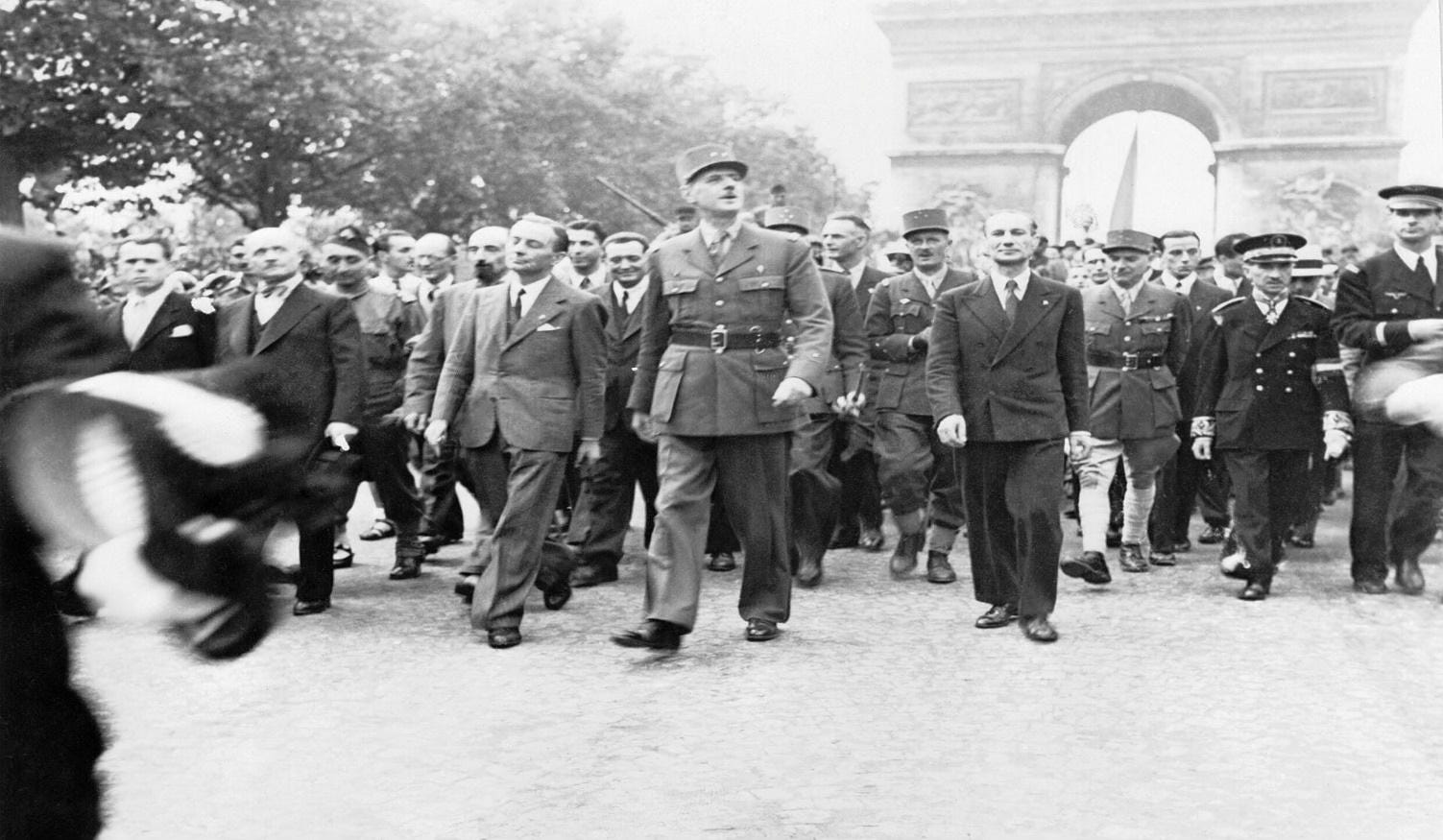
De Gaulle leading his men to attend Te Deum ceremony after Paris Liberation
Nevertheless, De Gaulle, fearing the indiscriminate slaughter of his countrymen, petitioned for an immediate frontal assault. Overruling Eisenhower’s decision, he even went so far as to threaten to detach the French 2nd Armoured Division, where they would assault the German forces in Paris alone. Finally, the 2nd Armoured Division, along with the US 4th Infantry Division, advanced towards the city. Despite repeated Hitler proclamations that Paris “must not fall into the enemy’s hands except lying in complete debris”, the Germans surrendered on 25th August. On the same day, De Gaulle gave one of his most celebrated speeches while standing on the porch of Hôtel de Ville declaring that Paris had been: “...liberated by itself, liberated by its people with the help of the French armies, with the support and the help of all France, of the France that fights, of the only France, of the real France, of the eternal France!” He discredited and dismissed the Vichy Regime as false France, vouched to take revenge and achieve justice for the humiliation France had endured for the last 4 years, and declared: “we will keep fighting until the final day, until the day of total and complete victory.”
This principle shaped the entire programme of the Provisional Government, which restored republican institutions without proclaiming a new republic, thereby asserting constitutional continuity rather than revolutionary rupture. This was significant because De Gaulle had previously denounced the parliament and the Republic’s functioning, especially their abdication to the Vichy regime. By creating this continuum, the General aimed to save the nation’s dignity and present the resistance as the preservation of the French nation. Historian Julian Jackson argues that de Gaulle’s greatest political achievement during this period was “to ensure that the Republic appeared to have survived the occupation,” thereby preserving France’s claim to legitimacy among both its citizens and the Allied powers. This insistence upon legal continuity enabled France to emerge from the Second World War not as a defeated nation liberated by foreign armies, but as a victorious Allied power whose legitimate government had continued to exist in exile. As Jackson observes, “De Gaulle’s most enduring success was to convince both France and the Allies that the Republic had never died.” This constitutional stance also prevented the Allies from imposing an occupation government similar to those established in Germany or Japan. It allowed France to participate directly in shaping post-war Europe.
The next stage was his war on collaborators: he wanted to show the Provisional Government as the restoration of public authority through the épuration, or purge of collaborators. Following liberation, widespread public anger erupted to produce uncontrolled acts of revenge against those accused of collaboration with Nazi Germany; the épuration sauvage (“wild purge”), as historians call it today, ended up killing somewhere around 10,000 alleged collaborators within a span of four months. De Gaulle sought to replace spontaneous violence with legal justice by establishing courts to prosecute collaborators while reaffirming the authority of the state. High-profile figures such as Marshal Philippe Pétain and Pierre Laval were brought to trial, symbolising the Republic’s determination to hold the Vichy leadership accountable. Although thousands of civil servants, police officers, journalists, industrialists, and local officials were investigated, de Gaulle repeatedly emphasised that national reconciliation required justice administered through legal institutions rather than mob violence.
“Liberated yet fragmented, broken and exhausted”
Political fragmentation emerged in France between the Liberation of 1944 and the elections of 1945. Although the defeat of Nazi Germany united most French political forces around the common objective of liberation, this unity quickly gave way to ideological rivalry once the immediate wartime crisis ended. The National Council of the Resistance (Conseil National de la Résistance—CNR) had brought together an exceptionally broad coalition during the occupation, including Communists, Socialists (SFIO), Christian Democrats, Radical Republicans, Gaullists, trade unions, and numerous Resistance organisations. As historian Julian Jackson notes, “The unity of the Resistance was largely a unity against the occupier; peace inevitably revealed profound political differences.” Once liberation was achieved, these differences surfaced rapidly, creating tensions between the CNR, the Provisional Government, and emerging political parties. The CNR had cultivated its program and summed up the objectives of the movement in March 1944, envisioning not only national liberation, but also radical political, social, and economic reforms. According to William Hitchcock, “The CNR program called for a new social democracy, to be achieved primarily by eradicating the concentrations of industrial and financial power”. Proposing the restoration of democracy, punishment of collaborators, expansion of workers’ rights, nationalisation of major industries, and centralised economic planning, it had a broad and ambitious agenda. While De Gaulle broadly accepted these social and economic reforms, he fundamentally disagreed with many Resistance leaders over the structure of political authority. The CNR contained influential Communist and Socialist elements that favoured a stronger role for representative assemblies and mass political participation. They also sought a greater role in the provisional government, which De Gaulle vehemently opposed. One can already see the big differences in the future idea of French government: even though De Gaulle claimed that his government represented “national unity”, there was only a single CNR representative in his cabinet—Georges Bidault, who was “neither a socialist nor a communist, but a Christian democrat”. This ideological battle was further complicated by the growing strength of the French Communist Party (PCF). Calling themselves the “party of the 75,000 shot”, Communists believed that having shed enough blood gave them legitimacy to become part of the national rebuilding efforts. They enjoyed strong support among industrial workers, trade unions, and many Resistance fighters. The Socialists (SFIO) also regained influence, with leaders Léon Blum and Paul Ramadier, veterans of the Third Republic, seeing themselves as the “hinge party, with friendly relations with both left and right”. The newly created Christian Democratic Popular Republican Movement (MRP) attracted moderate Catholics and conservatives. These three parties—the PCF, SFIO, and MRP—became the dominant political forces after liberation.
As each party sought to shape the post-war order according to its ideological priorities, cooperation within the provisional government became increasingly difficult. The political divisions became increasingly visible during preparations for France’s first post-war elections. In October 1945, French voters participated in a referendum asking whether a Constituent Assembly should draft a new constitution. While one silver lining for De Gaulle in these elections was that the electorate overwhelmingly rejected restoring the institutions of the Third Republic (reflecting widespread dissatisfaction with pre-war parliamentary instability), the nightmare quickly became apparent as the Constituent Assembly produced a fragmented political landscape. The Communist Party won approximately 26 per cent of the vote, the MRP about 24 per cent, and the Socialists around 24 per cent. Together, these three parties controlled the overwhelming majority of seats. Lacking his own political party to represent his ideals, De Gaulle increasingly grappled with and grew frustrated by the mounting strife and political tensions. Although De Gaulle continued as head of the provisional government, his growing dependence on parliamentary parties whose constitutional vision differed fundamentally from his own aggravated the problems.
Drafting of the new constitution became the major area of contestation. The Communist Party and the Socialists favoured a parliamentary republic in which executive authority would remain accountable to an elected assembly. Having witnessed the authoritarian experiences of Vichy, many politicians feared concentrating excessive power in a single executive leader. De Gaulle strongly opposed this approach. In his view, the collapse of France in 1940 had been caused partly by the weakness of parliamentary governments and the constant instability produced by coalition politics. He therefore argued that France required a directly legitimate and independent executive capable of ensuring continuity and national leadership. Relations between De Gaulle and the Constituent Assembly deteriorated steadily during late 1945 and early 1946. Parliamentary leaders increasingly challenged executive decisions, while De Gaulle became frustrated by what he called the “*régime des partis*” (rule of the political parties). He believed that party competition encouraged short-term political bargaining rather than the national interest—views at odds with those of the Assembly, who believed that parliamentary sovereignty represented the best safeguard against dictatorship. Neither side was willing to compromise on this constitutional issue. The conflict reached its climax on 20 January 1946, when De Gaulle unexpectedly resigned as head of the Provisional Government and ended his brief first run as the head of the government.
Grandeur
In the previous sections, we traced the journey of De Gaulle as a person, as the leader of the French liberation, and through his brief but substantial run as the head of the provisional government. This historical survey was necessary to understand the exact circumstances, his struggles, and the actions he took that transformed him into a statesman. While known as a stubborn and rigid figure, a careful look reveals that the General was accommodative and understood the needs of the time. During those deliberations and negotiations, his principled stand remained as firm as ever, but his decisions were taken based on pragmatism and the current situation. Historian Julian Jackson observes that “grandeur was not simply one policy among many; it was the organising principle of de Gaulle’s entire political worldview”. He never explicitly defined Grandeur, but he laid out his own imagination in his War Memoirs. Jackson notes that his ideas reflected his mystical thinking, which strangely also had a realist aspect around France. De Gaulle himself observes in his memoirs that in his vision of France, ‘sentiment inspires me as much as reason’.
One of the keystones of Grandeur was De Gaulle’s belief in the supremacy of the nation-state. Calling nation-states the “true representative of the people”, he believed ultimate legitimacy and efficacy lie in them as the true manifestations of the history of the people they represented. By invoking these ideas, the General was placing history and geography above any ideology. For him, an artificial community cannot be the beacon of people’s sovereignty and their protector, as it lacks legitimacy and because people with distant history and culture don’t have a stake in it.
This also explains why he was a sceptic of the war of ideology, which had been the defining characteristic of polity since the rise of Communism and Fascism. Hence, when John Foster Dulles and the Americans were propagating the international communist threat, De Gaulle predicted potential tensions and conflicts between the Soviet Union and China. A great historical mind, he stated that both of these nations have a long history of contestation and shared boundary disputes which, simply due to ideological conformity, won’t fade away. For de Gaulle, conflict between nations was the eternal law of history: “Like all life,” he told the French people in a televised address in 1960, “the life of nations is a struggle”. For the same reasons, he had several apprehensions regarding a pan-European entity and remained a stark critic of establishing supranational states like the European Union.
While his idea that nations and their conflicts are ubiquitous explains his realist thinking, his belief in the “destiny of France” showcases his sentiment and passion for his country. Writing in his memoirs, he declares that “France cannot be France without greatness”, explicitly stating that France is destined for a great role and a large, important place in the international sphere. This role, which he believed was not just for the prestige of France, was, according to him, “in the interest of the entire humanity”. He believed that past French greatness had conditioned the world to look to France for inspiration, as her ideas—which spread and influenced the concept of human rights—have shaped the lives of millions of people. For the General, France’s greatness was to be universal, and Europe, as Philip Gordon states, was to be a “Europe tricolore”.
This aspect of Grandeur possessed an important psychological dimension. The trauma of 1940 had shattered French confidence. Millions had experienced occupation, collaboration, and military humiliation. De Gaulle recognised that material reconstruction alone would not overcome this collective crisis. National morale required symbols capable of restoring pride and unity. Hence, when he returned to power in 1958, he clearly underlined the journey France must take in one of his speeches: “because she can, because everything summons her to do so, because she is France, [she] must lead a global policy in the centre of the world”.
Fall of the Fourth Republic and the Fifth Republic begins.
Between 1947 and 1958, the Fourth Republic witnessed more than twenty governments, making coherent policymaking difficult. Frequent cabinet collapses prevented consistent economic, social, and foreign policies, while party rivalries often took precedence over national interests. We have already talked about the General’s criticism of this system as the régime des partis (”party regime”), where he argued that political parties pursued their own ambitions rather than the common good. The Republic also struggled to address the challenges of decolonisation. Costly and divisive wars in Indochina (1946–1954) and Algeria (1954–1962) exposed the government’s inability to formulate coherent colonial policy, weakening public confidence and straining the armed forces. All these issues compounded and finally reached a tipping point with the Algerian Crisis of May 1958, when French military officers and settlers in Algeria feared that the Paris government would negotiate with Algerian nationalists and sacrifice France’s national interests for political gains.
On 13 May, French military officers and pieds-noirs in Algiers seized government buildings and established a Committee of Public Safety under General Jacques Massu. They demanded the return of Charles de Gaulle and insisted that he be appointed President “with extraordinary powers”, believing that only he could preserve “Algérie française”. There were even preparations for Operation Resurrection, a contingency plan involving the possible seizure of Paris if civilian politicians refused. Faced with the threat of military insurrection and potential civil war, the National Assembly invited the General, who answered the call with the precondition that he be conferred emergency powers and that a new constitution with a strong executive be drafted. On 1 June 1958, he became head of state, and with that, steps to establish the Fifth Republic began.
Working closely with Michel Debré, who became the principal architect of the new constitution, de Gaulle introduced a constitutional framework that fundamentally transformed the French political system. Approved overwhelmingly in a referendum on 28 September 1958, the Constitution of the Fifth Republic strengthened the executive while preserving democratic legitimacy. It created a powerful presidency with authority to appoint the Prime Minister, dissolve the National Assembly, submit legislation to referendums, chair the Council of Ministers, and exercise emergency powers under Article 16 during exceptional circumstances. Although the President was initially elected by an electoral college, de Gaulle further reinforced presidential legitimacy through the 1962 constitutional referendum, introducing the direct election of the President by universal suffrage. This reform established the presidency as the central institution of French politics. It reflected de Gaulle’s conviction that the head of state should derive authority directly from the nation rather than through parliamentary bargaining. The Fifth Republic also sought to rationalise parliamentary procedures, limiting the capacity of fragmented parties to destabilise governments through frequent votes of no confidence while maintaining parliamentary oversight. The establishment of the Fifth Republic was one of the first ideological victories de Gaulle had tasted. Still, he knew it was only one step and that more blocks were needed to erect the foundation of a new and powerful France.
Independence and the Nuclear Doctrine
If Grandeur was the ideological principle or the most important element, Independence for the General was the road that must be taken to make France an indispensable part of the world powers. Those years of exile and complete dependency on the Allies to liberate France taught the General bitter lessons. The fact that France’s interests, according to him, became secondary in the war irked him throughout the campaign, reaching its climax in the exchange between him and Eisenhower over the liberation of Paris. Therefore, he was determined to create a strategy or institutional framework that would prioritise French interests, French autonomy, and most importantly, French Defence.
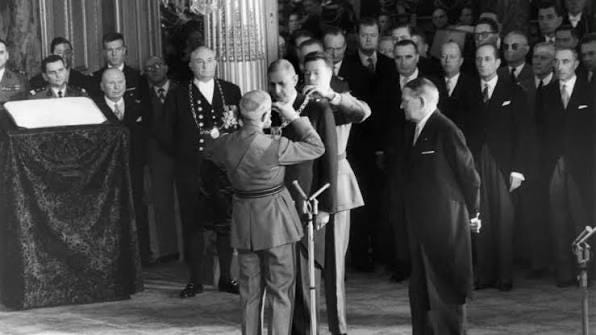
De Gaulle Presidential Ceremony at Élysée Palace, Paris
Philip Gordon explains Independence as what De Gaulle imagined: “denying the reciprocity of external relations and pretending that France could exercise complete autonomy in dealing with the world”. It may seem rather overambitious that a country like France—which had lost its great power status, a fact the General totally knew and accepted—was still determined to go on this route. Much like Grandeur, Independence was the “catalyst for self-confidence, pride and subsequent achievement”; hence, while being a strategic aspect of De Gaulle’s policy, it was also driven by sentiments. For him, independence must be the characteristic of France to avoid the “feeling of dependence”, which only breeds indolence, leniency, and a tendency to relapse. What others (and especially the leaders of the Fourth Republic) showed as cooperation and shared defence, he saw as dependence on foreign powers. Alliances, he accepted, were important, necessary, and in the case of managing a threat such as the Soviet Union, a matter of survival. However, that did not mean key decisions would be taken in Washington or London, or that France would be party to decisions that meant giving up or sacrificing France’s needs for collective European or NATO gains. Compromises, he asserted, are part of alliances, but voluntary surrender would mean surrendering France’s interests and putting a dent in its sovereignty. After his ascension to power in 1958, De Gaulle gradually began to construct his idea of France’s defence policy, starting with the removal of French naval forces from the Mediterranean Command in 1959. De Gaulle accelerated the development of an independent French nuclear force, known as the Force de Frappe, and conducted its first atomic test in the Algerian Sahara in February 1960. Finally, in 1966, he announced the country’s withdrawal from the alliance’s integrated military command structure and ordered the relocation of NATO’s Supreme Headquarters (SHAPE). Further studies have shown that, because of its own war engagements in Indochina and Algiers, France never fully committed its forces and resources to combined NATO defence.
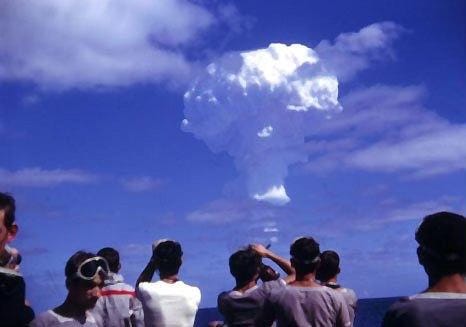
France tests its first Hydrogen Bomb Fangataufa Atoll, French Polyenasia
Hence, Philip Gordon asserts that De Gaulle, instead of dismantling, refused to erect this “Missing Pillar”. Therefore, the General’s policy was instead a reconstruction of the entire institutional framework, where he envisaged a two-tier defence strategy. The vision of this strategy was to preserve the French President’s absolute freedom to decide when France’s “vital interests” (intérêts vitaux) had been threatened. It must be noted that, while it is the most important aspect, this is just one of the various principles used to develop the comprehensive framework. Though it is not possible to lay out and elaborate on all of them, a brief discussion of the ideas propagated by three key figures to whom De Gaulle was sympathetic is warranted: Pierre Gallois, André Beaufre, and Charles Ailleret. Through their writings, we can build an understanding of French nuclear doctrine.
Let us begin with General Pierre Gallois. Gallois’s work Stratégie de l’âge nucléaire (1960) argued that the advent of nuclear weapons had completely altered the nature of warfare, and that the ability to inflict unacceptable damage upon an aggressor is now what potentially determines the outbreak of any major escalation. He developed the concept of “dissuasion du faible au fort“ (”deterrence of the strong by the weak”), contending that even a medium-sized power such as France could successfully deter a strong power if it could level a few major cities. Terming it an “equalising power”, he believed atomic technology created a new element in strategic powerplay because a handful of nuclear warheads could negate the advantages enjoyed by conventional military giants. Hence, he concluded that France did not require thousands of nuclear weapons like the United States or the Soviet Union; it required only a force sufficient to convince any aggressor that the cost of attacking France would outweigh any conceivable gain. Gallois’s ideas perfectly complemented de Gaulle’s determination to free France from dependence upon the American nuclear umbrella while preserving strategic autonomy.
General André Beaufre, on the other hand, addressed the psychological aspect of creating an independent nuclear force. In works such as Introduction à la stratégie (Introduction to Strategy, 1963) and Dissuasion et stratégie (Deterrence and Strategy, 1964), Beaufre asserts that nuclear deterrence was not just a matter of hard power posture, but a manifestation of a war of nerves. The objective of nuclear weapons was not to win battles, but to shape the enemy’s political calculations by creating uncertainty about the consequences of aggression. Successful deterrence depended upon credibility, political will, and the ability to manipulate escalation rather than overwhelming destructive capacity. Nuclear force, according to him, had become a way to project power, influence diplomatic decisions, and compel opponents to readjust their conventional tactics and strategy. Hence, nuclear weapons were not just an independence tool, but a pillar of the General’s Grandeur vision.
Finally, there is General Charles Ailleret’s interpretation, which has come to be known as the “strategic tripwire” concept. According to Philip Gordon, this blueprint was confirmed by de Gaulle himself in a conference where he stated that “France saw the central front in terms of two potential battles, the first one in Germany and the second one on the Rhine”. French conventional forces stationed in West Germany, particularly the 1st French Army, were not intended to wage an extended war of attrition against the Warsaw Pact. For Ailleret, their principal mission was to assess the scale and intentions of a Soviet offensive. Therefore, the main question would be whether a Soviet attack was a limited operation confined to Germany or the beginning of a broader invasion threatening France itself—put by Philip Gordon as “two types of aggression, limited (limitée) and unmistakable (caractérisée)”. It was unmistakable aggression that would trigger a nuclear response. If Soviet forces appeared content to occupy or defeat West Germany without advancing further west, France retained the political option of limiting its military involvement, which would be deemed a “German-American affair to which France might or might not have something to contribute”. However, if intelligence and battlefield developments indicated that Soviet forces intended to continue towards the French frontier, the conflict would directly threaten France’s sovereignty, justifying and leading to “a national nuclear threat”. He combined this scheme with his concept of “dissuasion tous azimuts“ (”deterrence in all directions”). Ailleret explains de Gaulle’s thinking, who wanted French nuclear forces to be capable of deterring any potential aggressor regardless of alliance or ideology, thereby creating a truly independent nuclear doctrine designed to deter Soviet aggression while balancing US hegemony in European affairs. It was the amalgamation of these discussed ideas that created the French Nuclear Doctrine, manifesting de Gaulle’s goal that “The defence of France must be French” into reality. Today, France’s nuclear arsenal consists of around 290 nuclear warheads, encompassing both air-based and submarine-based delivery capabilities. France remains one of the largest manufacturers of equipment and aircraft, and one of the leaders in various advanced technologies, a testament to the brilliance of De Gaulle’s ideology and vision.
De Gaulle, while being celebrated, has remained a controversial figure in French politics. Even today, French politicians tend to identify themselves as Gaullists or anti-Gaullists. In other NATO countries such as America and the UK, he becomes even more controversial, and any discussion of him produces strong emotions from both his opponents and supporters. Yet, no one can deny his legacy and the influence which he left on French institutions and NATO. For everyone interested in statecraft, foreign policy, nuclear doctrine, and defence policy, reading him will forever remain crucial.
 | A guest post by
|